
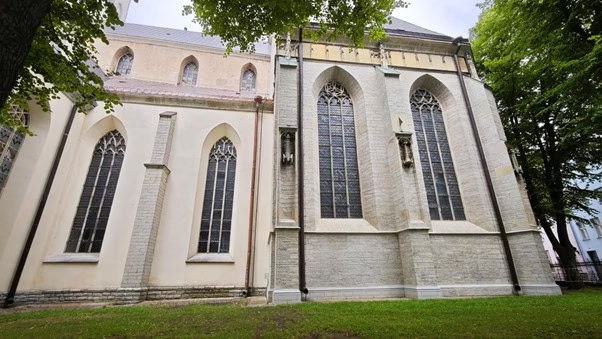
The garden of St. Olaf’s Church is adorned by St. Mary’s Chapel. The chapel is first mentioned in historical records in 1404, but this original structure was demolished during the reconstruction of the church’s nave.
The present St. Mary’s Chapel was built between 1513 and 1523. It is a magnificent example of Late Gothic architecture and, with its refined craftsmanship and rich decorative forms, is considered Estonia’s most elaborate architectural monument of the period. The chapel, however, remained unfinished: the wall niches were never filled with sculptures, and parts of the decorative friezes were left incomplete. The arrival of the Lutheran Reformation eliminated the need for such an ornate chapel.
Cenotaph of Hans Pawels
Set into the exterior east wall of St. Mary’s Chapel, between two buttresses, is the memorial commissioned by the church warden and initiator of the chapel’s construction, the merchant Hans Pawels. This cenotaph (1513) conveys biblical wisdom through an inscription carved in Low German.
The monument consists of two parts. Below is a wall tomb in the form of a niche, containing a skeleton with a toad resting on its chest and a snake beside its skull. These symbols represent the dual nature of the human heart and the corruption of human thought. Yet the message is ultimately one of hope: above the tomb unfolds the story of Christ’s Passion, proclaiming that Christ has already borne humanity’s suffering and leads believers through death into life.
The reliefs depicting the Passion of Christ illustrate the following scenes:
- Entry into Jerusalem
- The Last Supper
- Prayer on the Mount of Olives
- Arrest
- Before Caiaphas
- Scourging
- Before Pilate
- Carrying the Cross

of the Chapel of St. Mary
Hans Pawels’ Cenotaph on the Exterior Wall of St. Mary’s Chapel
Hans Pawels’ cenotaph (an empty tomb) is designed in the form of a Late Gothic altarpiece. At the top is an ornamental frame with an empty central niche, flanked by two open altar wings, each containing four carved reliefs depicting scenes from the Passion, set within profiled stone frames.
The predella of the altarpiece contains a niche with a five-line inscription in Low German:
“Dat ick vorgaf is mi gebl (even) Wes ick behelt heft my bo(geven)
(H)irvme sal sik nemant to h(och er) heven Also roek vorgheyt des myn
seen leuen hans pawls degechtnisze 1513”
Translation:
“What I have given is left to me;
what I have possessed is lost to me.
Therefore no one should exalt themselves too highly,
for human life passes like smoke.
In memory of Hans Pawels, 1513.”
The same panel also bears a heraldic shield displaying the Pawels family mark.
Hans Pawels’ cenotaph is regarded as one of Estonia’s finest Late Gothic works of art, distinguished by the quality of its execution and composition. It is also one of the rare medieval artworks in Estonia for which both the date of creation and the artists are documented. The principal designer is believed to have been the Polish master stonemason and builder Clemens Pale, whose work was continued by Hinrik Byldensnyder of Westphalia. Both craftsmen also participated in the construction of St. Mary’s Chapel.
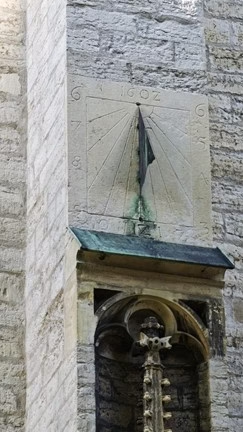
Sundial
From the church garden, visitors can see the sundial on the south wall of St. Mary’s Chapel. Created in 1602 by the renowned Tallinn stonemason Arent Passer, it is the oldest surviving sundial in Estonia.