
The exact date of the construction of the first church building of St. Olaf’s remains unknown. Historical records show that in 1267, Margaret, the mother of Danish King Eric VI Menved (Klipping), donated the right of patronage over St. Olaf’s Church and its parish to the Cistercian convent of St. Michael. This is the first written reference to St. Olaf’s Church. This year, or a period shortly before it, has traditionally been considered the date of the church’s construction. According to this interpretation, the church was built only after the Danes conquered the Estonian stronghold and founded Tallinn (then Taani-linn, “Danish Town”).
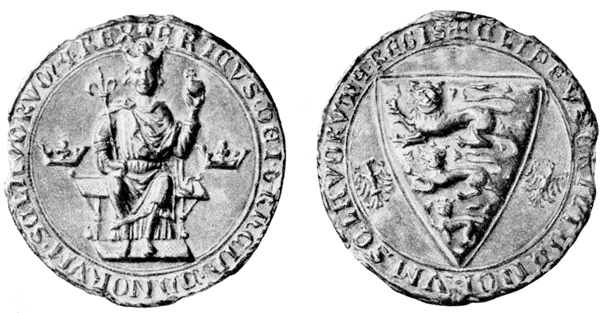
The seal of King Erik V Klipping of Denmark.
In 1951, the former director of the Tallinn City Archives, Paul Johansen, published a study attempting to prove that before the arrival of the Danes there had already been an Estonian fortress and settlement here, as well as a Scandinavian trading settlement with a church — specifically, St. Olaf’s Church. This claim has not yet been confirmed archaeologically or through written sources, but it remains a plausible and currently unrefuted hypothesis.
Evidence Supporting the Existence of the Church Before the 13th Century
The period from the 9th century to the middle of the 11th century is known as the Scandinavian Viking Age. Towards the end of this period, the trade route known as “the route from the Vikings to the Greeks” emerged. Part of this route passed through Estonian waters — from the area of the island of Naissaar along the northern coast of Estonia towards the mouth of the River Neva.
To protect themselves from possible raids by coastal Estonians, mutual protection agreements had to be established, as was common at the time. At the same time, early feudal relationships were beginning to develop among Estonians: power structures based on land ownership emerged, and trade connections across the Baltic Sea and Northern Europe became more active.
Goods traded included furs, wax, honey, salt, weapons, metals, slaves, and luxury goods, allowing participation in international commerce. One condition of trade agreements was often the establishment of mutual trading settlements on each other’s territories.
For example, the people of Gotland had their own church dedicated to St. Olaf in Novgorod around 1080, and by the end of the 12th century they also had a trading settlement there. At the same time, there was a Russian church dedicated to St. Nicholas on Gotland, probably accompanied by a trading settlement.
It has been proven that Tallinn already had a Russian church with a cemetery during this period. If the Russians had their own church and trading centre in Estonia, it is possible that the Scandinavians had one as well, especially considering their even closer connections with the Estonians.
All Scandinavian missionary activity in Estonia supports the idea that before the arrival of the Danes there must already have been Estonian and Scandinavian Christians in Tallinn. If there were Christians, there must also have been a place of worship, because Roman Catholic religious practice has always been closely connected with sacred buildings.
Legends about the construction of churches usually spread only within a single parish, but legends concerning St. Olaf’s Church and its construction have spread much more widely. They have been recorded in 45 parishes, with a total of 91 versions.
The general story tells of a miser named Olev, who builds a great church for a large payment. At the final moment, while placing the cross on top of the church, he hears someone calling:
“Olev, keep the cross straight!”
The miser falls from the tower and dies. According to the legend, after he hits the ground, a toad and a snake crawl out of his mouth.
Similar legends exist among the Livonians, but especially among Scandinavian peoples. The widespread nature of these legends demonstrates the exceptional importance or considerable age of St. Olaf’s Church. The Estonian folklorist Oskar Loorits dated the origin of the legends of St. Olaf’s Church in Estonia to the 12th century, that is, before the arrival of the Danes.
The Name of St. Olaf’s Church
The church received its name from the Norwegian King Olaf Haraldsson (995–1030). As a young man, Olaf participated in Viking raids in Western Europe, where he was baptized. After returning to Norway in 1015, he liberated the country from Danish and Swedish rule.
He ruled Norway until 1028, when he was forced to flee to Kyiv after a rebellion by pagan nobles. There he sought refuge with his relative, Prince Yaroslav the Wise. Olaf returned to Norway in 1030 to regain his throne but was killed on 29 July in the Battle of Stiklestad against the forces of Danish King Canute the Great.
After his death, Olaf was canonized as a saint, and the anniversary of his death became a national holiday in Norway. The cult of St. Olaf spread throughout Scandinavia and Estonia, and the church bearing his name in Tallinn became known as St. Olaf’s Church (Oleviste Church).
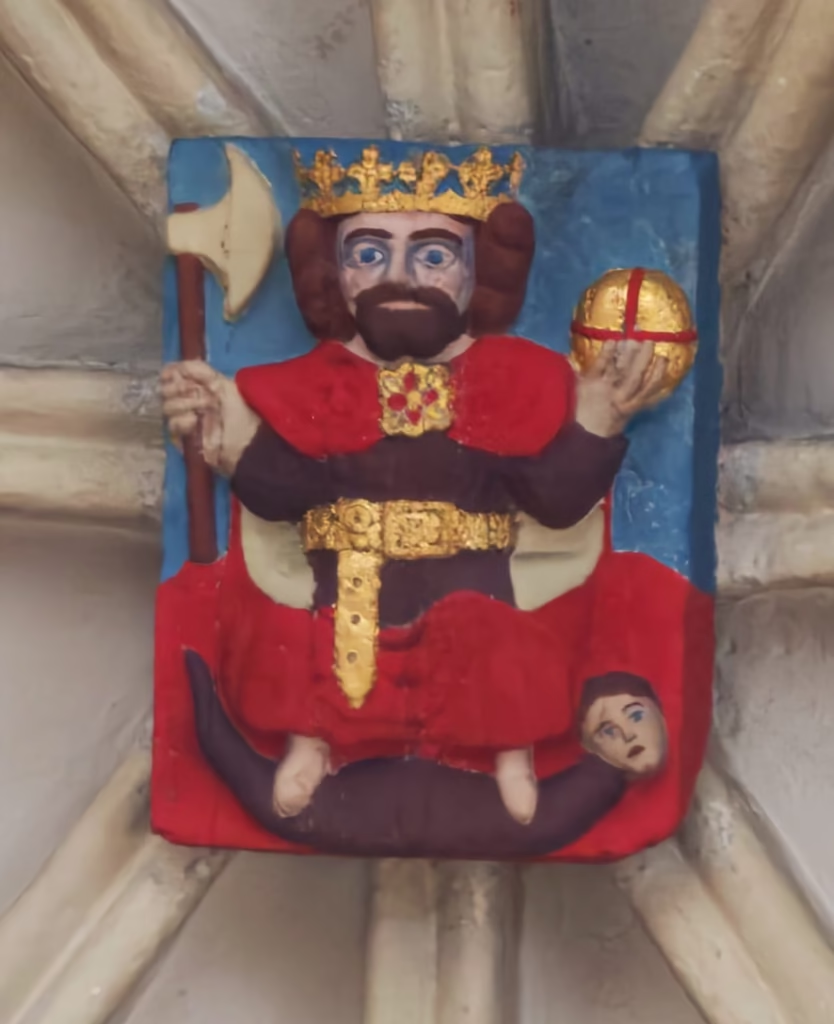
Headstone. Olaf II Haraldsson (known during his lifetime as Olaf the Stout (Olav Digre), and after his canonization as Saint Olaf; 995 – 29 July 1030) was King of Norway from 1015 to 1028.
Construction phases of the church
The original church
There is no information about the construction technique or architecture of the church built before 1219, nor is its exact location known. Possible locations include: the site of the current vestry, where traces of an earlier structure exist,
the chancel area, where fragments of buildings not belonging to the current church were found in 1958, the area opposite the present church between Lai and Laboratooriumi streets.
The church in the 14th century
At the beginning of the 14th century, construction of a new church began and was completed in. In 1364, a lower tower was built on a foundation 4.5 meters in diameter. At that time, the tower stood outside the church.
15th-century reconstruction
In the 15th century, the church was rebuilt and acquired its present late medieval form. First, a spacious new choir was constructed. Its architectural style is very similar to other contemporary buildings in Estonia, such as the Great Guild Hall and likely the churches of the Dominican and Pirita monasteries.
On May 11, 1433, a major fire broke out in Tallinn, destroying part of the city and leaving St. Olaf’s Church half in ruins. The choir was quickly restored and consecrated in 1439. At the same time, it was decided to enlarge the church. The earlier nave (built in 1330) and its chapels were demolished. Construction lasted from 1436 to 1450. The church became longer and wider,
reaching its current size. The new church was built as a three-aisled basilica. The central nave, covered with star vaults, rises to 31 meters, making it the tallest in the Baltic region. The stone part of the tower reaches 57 meters. The spire, completed in 1450, was about 159 meters high at the time, making it one of the tallest in Western Europe. In the 15th century, three chapels are mentioned: those of St. Mary, St. Olaf, and St. Lawrence. The church was surrounded by a cemetery located where Oleviste Street now runs.
The Chapel of St. Mary
The Chapel of St. Mary is first mentioned in 1404 but was demolished during the rebuilding of the nave. A new chapel was constructed between 1513 and 1523. It is a magnificent example of late Gothic architecture and one of the most richly detailed structures in Estonia. The chapel remained unfinished—sculptures are missing and the friezes incomplete—likely due to the arrival of the Reformation.
On the eastern exterior wall is the cenotaph of Hans Pawels, a church elder and main patron of the chapel’s construction. It consists of two parts: below is a wall tomb with a skeleton, a toad on its chest, and a snake near the skull; above are reliefs depicting scenes from the Passion of Christ:
- Entry into Jerusalem
- The Last Supper
- Prayer on the Mount of Olives
- Arrest
- Before Caiaphas
- Scourging
- Before Pilate
- Carrying the Cross
An inscription in Low German reads in translation:
“What I have given remains mine; what I have owned is lost.
No one should think too highly of themselves, for human life passes like smoke.”
Iconoclasm
The richly decorated church once contained 25 altars. With the Lutheran Reformation, which in Tallinn began at St. Olaf’s, popular religious fervor turned destructive. On September 15, 1524, much of the church’s valuable interior was destroyed during iconoclasm. The building itself, however, remained intact.
Fire of 1625
On the night of May 29, lightning struck the tower. The tower burned, the bells melted, and all interior furnishings acquired after the Reformation were destroyed. Only the walls remained. The church was quickly restored and reopened within three years. The octagonal tower with corner turrets was completed in 1651. St. Olaf’s Church has suffered from fires more than any other church in Tallinn. It has burned down completely at least three times, and lightning has struck the tower eight times.
The Fires of 1820 and 1831
On the night of 16 June 1820, lightning struck one of the corner towers and set it on fire. Twenty to thirty young men were ready to climb up and extinguish the flames, but authorities, remembering the consequences of the 1625 fire for neighbouring buildings, ordered the evacuation of all nearby houses.
The corner tower continued to burn slowly. Soon the other towers caught fire, and shortly afterwards the main tower was engulfed in flames and eventually collapsed onto the sexton’s house. The fire lasted four hours.
Everything inside the church was destroyed: metal objects melted, gravestones cracked from the heat, and even the stone pillars supporting the building were damaged. The organ purchased from Halle in 1771 was destroyed. Only the walls and the valuable Oleviste Library, which had been safely hidden beneath the vaults of the sacristy, survived.
The restoration of the church was supported by Emperor Alexander I and later by Emperor Nicholas I. In 1828, renovation work began. Reconstruction was complicated by another smaller fire on 27 July 1831, when lightning again struck the main tower. The fire was extinguished, and the tower was rebuilt according to the original design.
Over time, the gilded cross and sphere at the top of the tower had become covered with soot. They were cleaned but were not gilded again. The sphere has a diameter of 114 cm. The current height of the tower from the ground is 123.7 metres.
In 1833, heating stoves were installed in the church. By 1840, the restoration work was completed, and the church was reopened for worship.
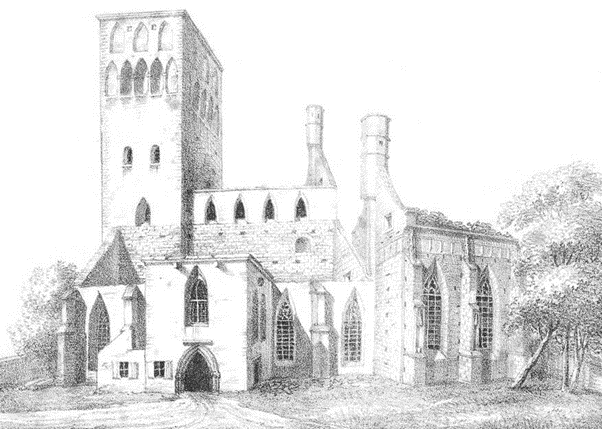
St. Olaf’s Church in a drawing by Carl Siegismund Walther after the fire of 1820.
The church after 1950
In September 1950, the building—heavily damaged by war—was handed over to the Tallinn Oleviste Congregation of the Union of Evangelical Christians-Baptists. Restoration began immediately after the reopening service on September 17, 1950, and was completed by December 23 the same year.
In 1954, extensive interior renovations were carried out. Thick layers of soot and dirt accumulated over decades were removed, restoring the church’s interior dignity.

French cultural figure and diplomat Catala once described the architecture of St. Olaf’s Church as “stripped Gothic.” Compared to Western European Gothic cathedrals, it is outwardly simple, yet in its simplicity it is imposing. Due to its size and uniqueness, it is one of the most remarkable buildings in Estonia. All elements of the structure—especially the powerful tower
rising toward the clouds with its golden cross—emphasize an upward striving.
Ernst Ader
Ernst Ader (1898–1991) was a researcher of Estonian church history and a preacher at St. Olaf’s Congregation.