
The organ of St. Olaf’s Church was built by the workshop of Eberhard Friedrich Walcker in Germany. Originally completed in 1842 as Opus 34, it underwent a major modernization and expansion in 1914, receiving the new designation Opus 1811. Unfortunately, the outbreak of the First World War interrupted the work. It was not until Christmas 1926 that approximately half of the organ could be reinstalled, and in that form it has remained to this day.
To fully appreciate the unique sound of the St. Olaf’s organ, it is necessary to examine its historical development.
By 1842, the reconstruction of the church, which had been destroyed by a lightning-induced fire twenty-two years earlier, had progressed sufficiently for a new organ to be installed. The instrument had been built in Ludwigsburg, Germany, by the workshop of Eberhard Friedrich Walcker. Founded only a few decades earlier, the Walcker firm had already established a strong reputation in Germany and grown into a major factory through prestigious commissions.
Walcker entered the Russian market in 1839 with the completion of a large organ for St. Peter’s Church in St. Petersburg. It was therefore entirely natural that Tallinn’s principal church, St. Olaf’s, should commission its new organ from the same builder. In fact, there was no organ builder in the region capable of constructing an instrument of the required size.
The original 1842 organ (Walcker Op. 34), with a mechanical action, featured 65 stops, three manuals, and a pedal division. It was the largest organ ever built for Estonia and remained so until 1914, when the renovated organ of Tallinn Cathedral was completed.
The 1914 Modernization Project
Technological innovations introduced into organ building at the turn of the twentieth century spread rapidly throughout Europe. The economic prosperity preceding the First World War made it possible to implement these developments in Estonia as well. One after another, the organs of Tallinn’s major churches were converted to pneumatic action.
At St. Olaf’s Church, this modernization was undertaken only in the spring of 1914, after many years of advocacy by the church’s organist, Weÿrich. A detailed reconstruction plan was prepared by Dr. Wissig, organist of St. Peter’s Church in St. Petersburg. The guiding principle of the project was the preservation of the instrument’s original tonal character.
The proposed design called for 76 stops, of which 59 existing stops were to remain in use. However, events unfolded differently. A service leaflet distributed at the organ’s dedication service on 18 December 1926 explained::
“The reconstruction and enlargement of our old organ was commissioned in December 1913 and was expected to be completed and installed by September 1914. The war and revolution disrupted everything, and the funds that had been collected lost all value. Only in 1924 did the church council decide to launch a new fundraising campaign, and on 4 January 1926 a new contract was signed with E. F. Walcker of Ludwigsburg. In view of the difficult financial situation of our congregation, the installation of the organ was planned in several stages. Today, the first and largest stage stands before us ready for use. The console, together with all necessary mechanisms and couplers, has been completed and installed for the entire instrument, meeting modern technical requirements. The specification, in which part of the usable old pipework has been retained, is as follows.: (see disposition).”

The Organ Case
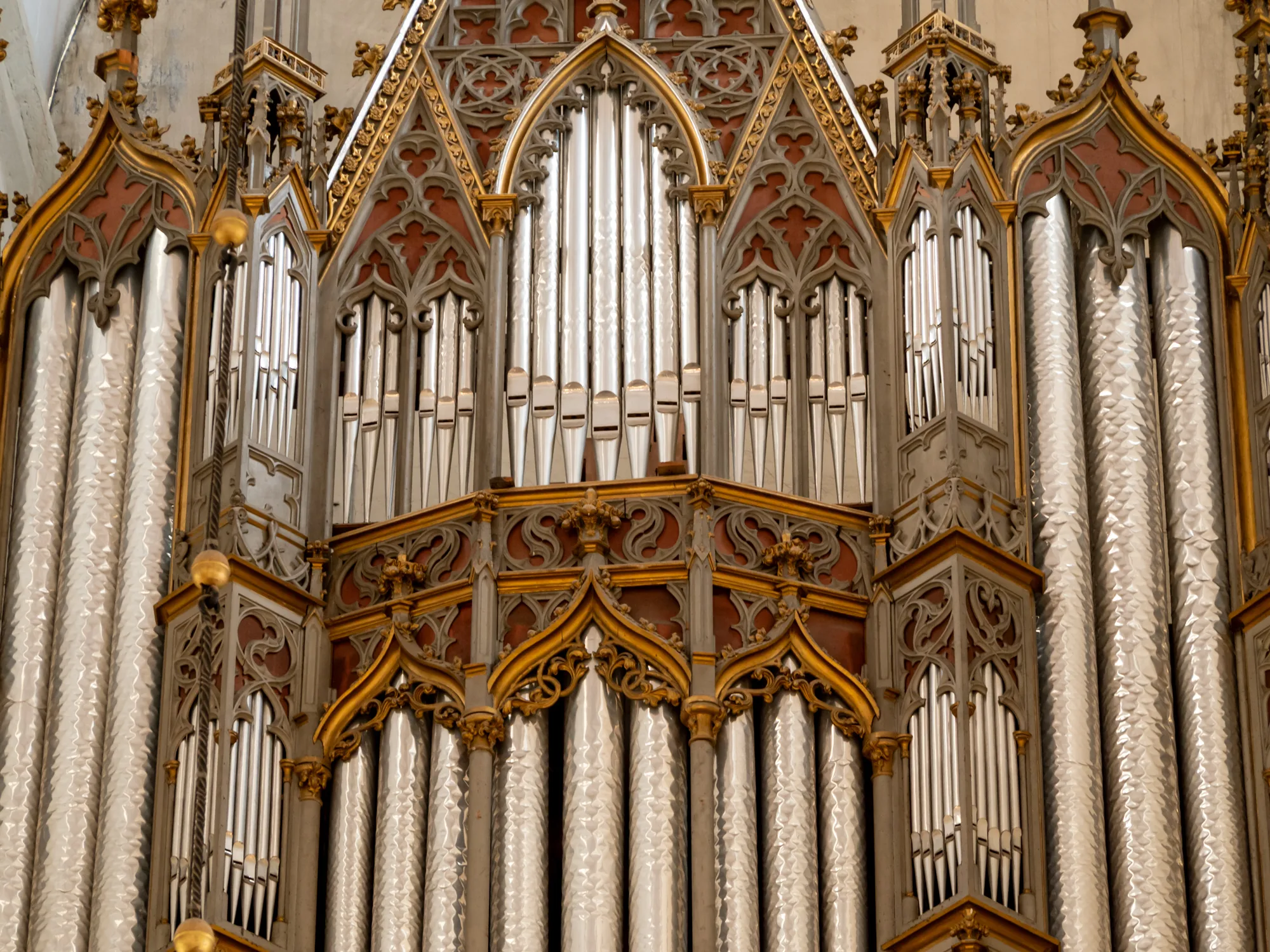
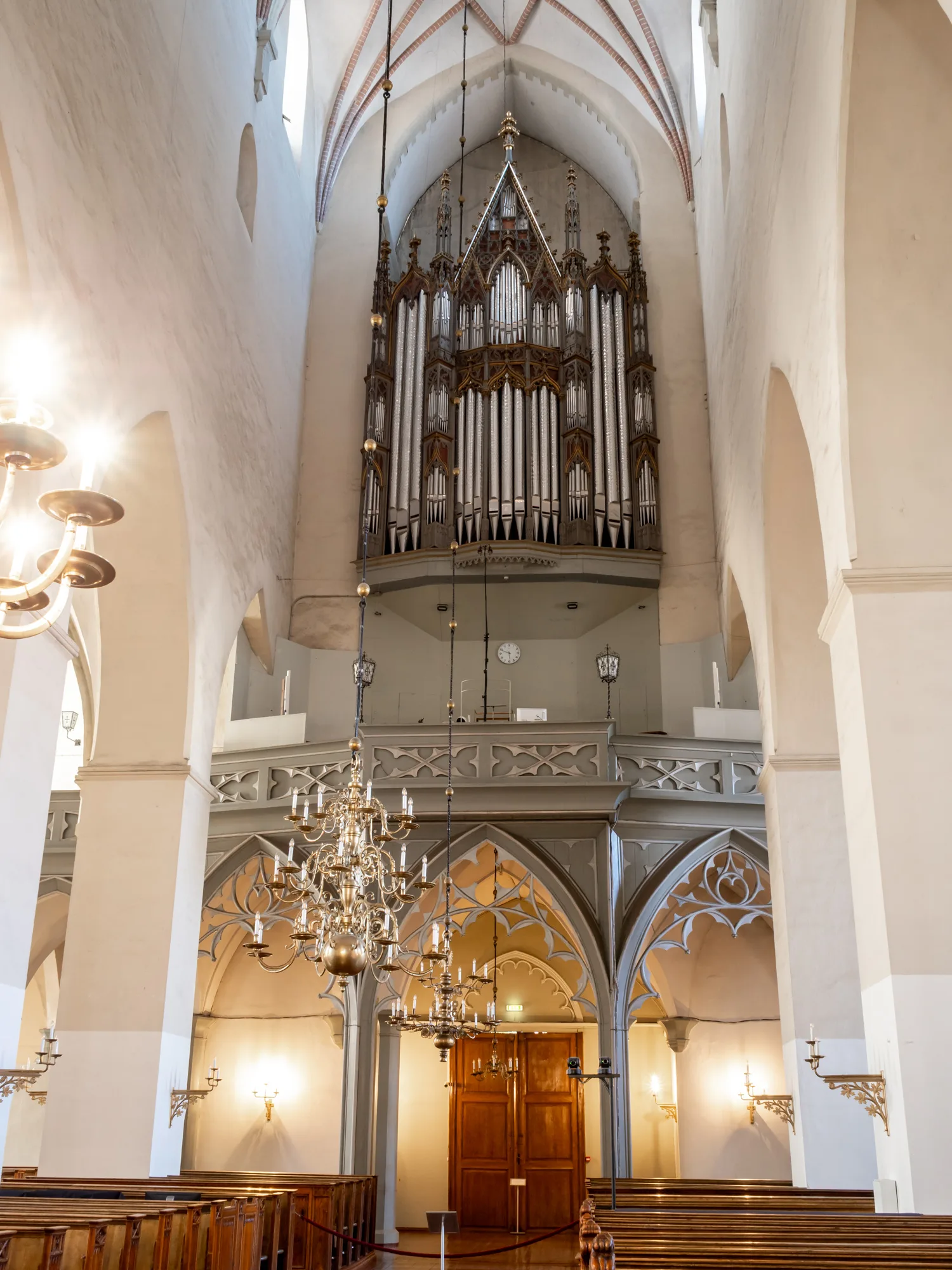
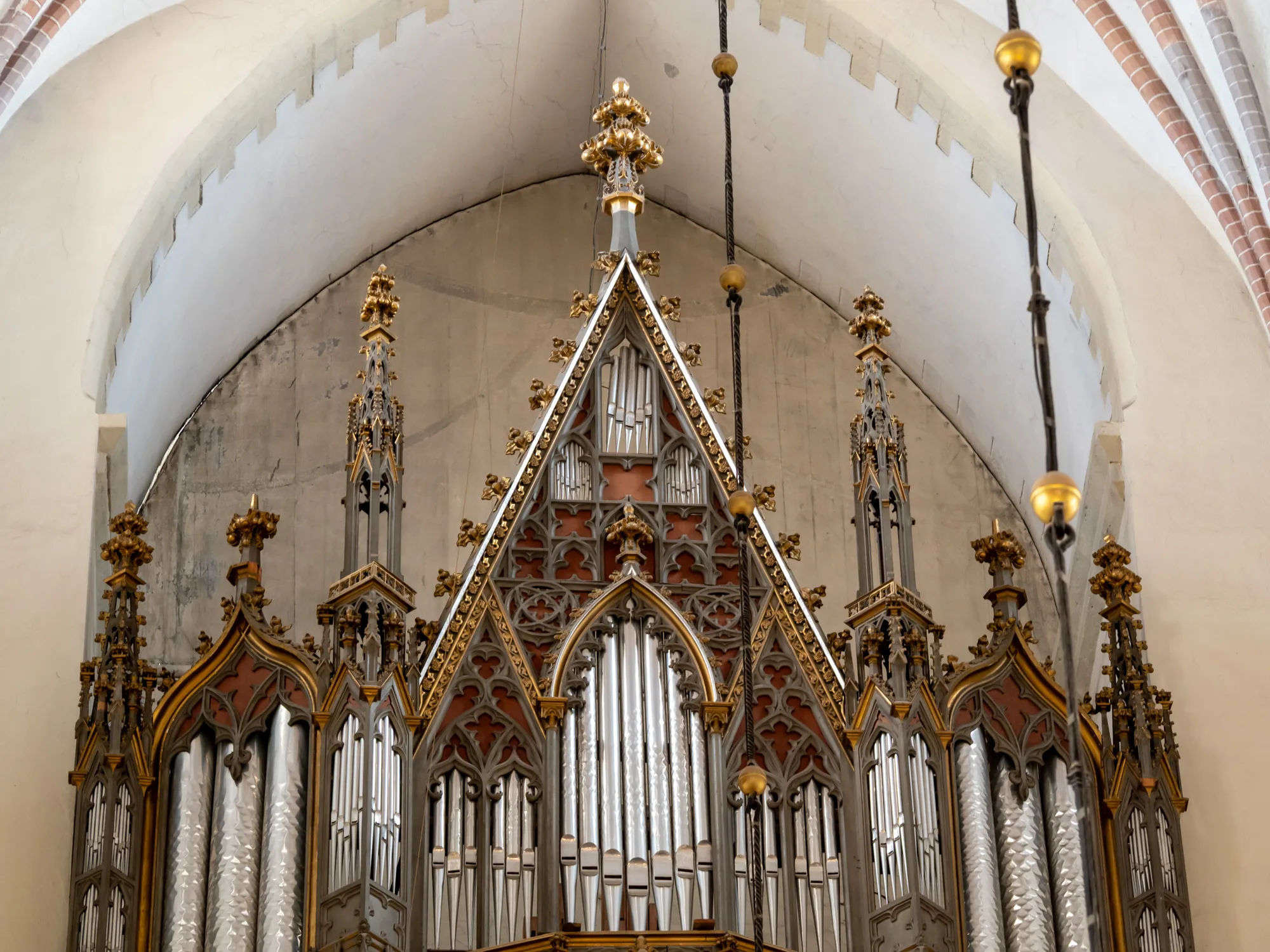
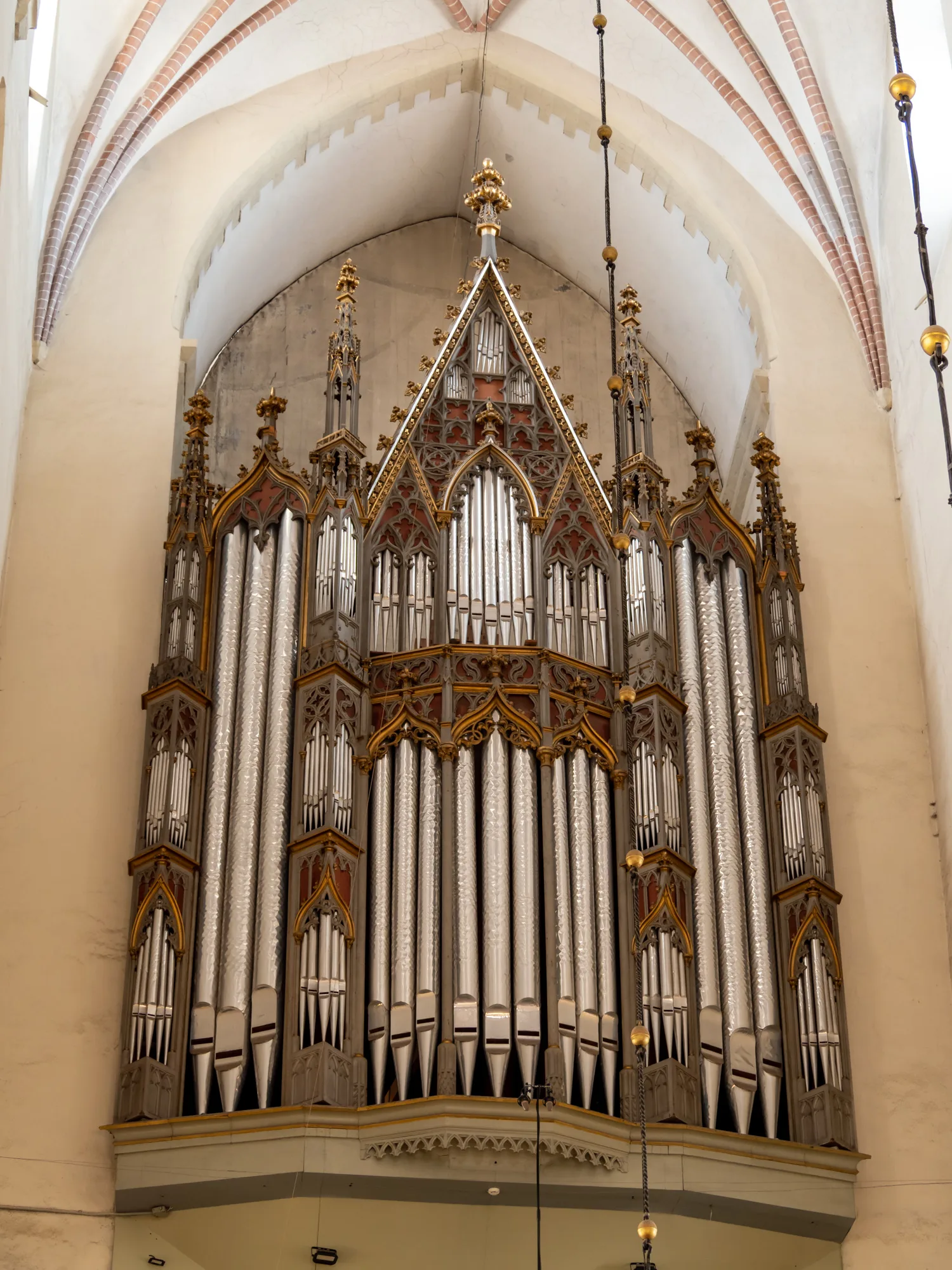
The organ’s Neo-Gothic façade, dating from 1842, was reinstalled only after 1950. Since the pipework of the First Manual was never completed, the façade could not display functioning pipes as originally intended. Instead, the visible pipes are non-speaking replicas made of cardboard and covered with silver foil.
Historical Significance
Recent archival research has demonstrated that the St. Olaf’s organ is a significant monument in the history of Estonian organ building. Following its completion in 1842, it served as an important model and source of inspiration for local organ builders.
Restoration and Expansion Since 2016
Since 2016, the organ has been maintained by Mäeväli Organ Workshop Ltd., which has undertaken a series of extensive restoration projects. These works have made it possible to add new stops to positions that had originally been prepared on the windchests.
The pedal division has received three additional 16-foot stops, using historical pipes that had been preserved in the church attic and were restored for installation. The Oboe 8' and Flûte harmonique 8' were newly constructed specifically for the St. Olaf’s organ.
For the Third Manual, where numerous stops were missing, organ expert Marko Koskinen facilitated the acquisition of pipework from the former organ of Juupajoki Church in Finland, originally built in 1917.
As a result of these efforts, nine stops have been added over the past decade, bringing the organ’s total to 46 stops today.
Toomas Mäeväli
Liina Rahuoja
Disposition- E. F. Walcker III/76 Op. 1811/1914
1. manuaal C – g3
| 1 | Prinzipal | 16’ | alt |
| 2 | Bourdon | 16’ | neu |
| 3 | Prinzipal | 8’ | alt |
| 4 | Gamba | 8’ | “ |
| 5 | Flöte | 8’ | “ |
| 6 | Rohrflöte | 8’ | neu |
| 7 | Gemshorn | 8’ | alt |
| 8 | Dulciana | 8’ | neu |
| 9 | Quinte | 5 1/3’ | alt |
| 10 | Oktave | 4’ | “ |
| 11 | Fugara | 4’ | “ |
| 12 | Gemshorn | 4’ | neu |
| 13 | Flûte harm. | 4’ | “ |
| 14 | Gedeckt | 8’ | alt |
| 15 | Nasard | 2 2/3’ | “ |
| 16 | Oktave | 2’ | “ |
| 17 | Terz | 3 1/5’ | “ |
| 18 | Cornett I - V | 8’ | “ |
| 19 | Mixtur V | 2’ | “ |
| 20 | Tuba | 16’ | “ |
| 21 | Trompete | 8’ | “ |
| 22 | Clairon | 4’ | neu |
2. Manual C – g3 (g4) Schwellwerk
| 23 | Bourdon | 16’ | alt | |
| 24 | Geigenprinzipal | 8’ | “ | |
| 25 | Salicional | 8’ | “ | |
| 26 | Gedeckt | 8’ | “ | |
| 27 | Dolce | 8’ | neu | |
| 28 | Flûte harmonique | 8’ | “ | Mäeväli 2019 |
| 29 | Fugara | 8’ | alt | |
| 30 | Quintflöte | 5 1/3’ | “ | |
| 31 | Oktave | 4’ | “ | |
| 32 | Violine Pfeif. 3. man Dolce | 4’ | “ | |
| 33 | Traversflöte | 4’ | “ | |
| 34 | Quinte | 2 2/3’ | “ | |
| 35 | Oktave | 2’ | “ | |
| 36 | Cornett-Mixtur II – V | “ | ||
| 37 | Scharff III | neu | ||
| 38 | Horn | 8’ | “ | |
| 39 | Klarinette | 8’ | alt |
3. Manual C – g3 (g4) Schwellwerk
| 40 | Gedeckt | 16’ | alt | |
| 41 | Gamba | 16’ | “ | |
| 42 | Prinzipal | 8’ | “ | |
| 43 | Gedeckt | 8’ | “ | |
| 44 | Konzertflöte | 8’ | neu | Kangasala 1917/2016 Mäeväli |
| 45 | Aeoline | 8’ | “ | Kangasala 1917/2016 Mäeväli |
| 46 | Voix celeste | 8’ | “ | Kangasala 1917/2016 Mäeväli |
| 47 | Hohlpfeife | 8’ | alt | |
| 48 | Quintatoen | 8’ | “ | |
| 49 | Viola | 8’ | neu | Kangasala 1917/2016 Mäeväli |
| 50 | Flûte d’amour | 4’ | alt | |
| 51 | Spitzflöte | 4’ | “ | |
| 52 | Dolce ersetzt durch Prinzipal | 4’ 4’ | “ unbek | |
| 53 | Waldflöte | 2’ | alt | |
| 54 | Harmonia aetheria | 8’ | “ | |
| 55 | Trompette harmonique | 8’ | neu | |
| 56 | Oboe | 8’ | “ | Mäeväli 2016 |
Pedal C – f 1
| 57 | Prinzipalbass | 32’ | alt | |
| 58 | Untersatz Transm. v 63 u. 40 | 32’ | “ | |
| 59 | Oktavbass | 16’ | “ | Walcker 1842/2026 Mäeväli |
| 60 | Subbass | 16’ | “ | |
| 61 | Violon | 16’ | “ | Walcker 1842/2026 Mäeväli |
| 62 | Gedacktbass Transm. v. Nr. 40 | 16’ | “ | |
| 63 | Gambenbass Transm. v. Nr. 41 | 16’ | “ | |
| 64 | Oktavbass | 8’ | “ | |
| 65 | Flötenbass | 8’ | “ | |
| 66 | Cello | 8’ | “ | |
| 67 | Dulciana Transm. v. Nr 25 | 8’ | “ | |
| 68 | Quintbass | 10 2/3’ | “ | |
| 69 | Quintbass | 5 1/3’ | “ | |
| 70 | Prinzipalbass | 4’ | “ | |
| 71 | Flautobass | 4’ | “ | |
| 72 | Waldflöte | 2’ | “ | |
| 73 | Posaune | 16’ | “ | Walcker 1842/2026 Mäeväli |
| 74 | Serpent | 16’ | “ | |
| 75 | Trompete | 8’ | “ | |
| 76 | Clairon | 4’ | “ |
III/II, III/I, II/I, I/P, II/P, III/P, Sub III/I, Sup III/I, Sub II/I, Sup II/I, Sub III/II, Sup III/II, Sub III, Sup III, Sub II, Sup II, Sub III/P, Sup II/P, Sup III/P
Pianopedal fürs II und III Man
4 freie Kombinationen
5 feste Kombinationen
Piano, Mezzoforte, Forte, Tutti, Tutti Pedal.
Walze
Zungenchor
Generalauslöser Koppeln aus Walze
alt- Pfeifen von 1842neu- Pfeifen von 1926