
Catholic Congregation
Historically, Estonia has been influenced by Christianity from both the East and the West. Through the Crusades, as well as earlier contacts, Estonia became a Catholic land dedicated to the Virgin Mary. For eight centuries we have been known as Maarjamaa (“Land of Mary”).
St. Olaf’s Church was founded as a Catholic place of worship and served as such until the Lutheran Reformation.
The Reformation – Evangelical Preachers
In 1523, the first reformers arrived in Tallinn from Germany: former monk Johann Lange, who began preaching in St. Nicholas’ Church, and chaplain Zacharias Hasse, who served at St. Olaf’s Church.
The patron of St. Olaf’s Church was the Cistercian St. Michael’s Monastery. Despite the monastery’s opposition, Hasse became the preacher of the St. Olaf’s congregation in 1524. Lange became the preacher at St. Nicholas’ Church.
The Wanradt–Koell Catechism
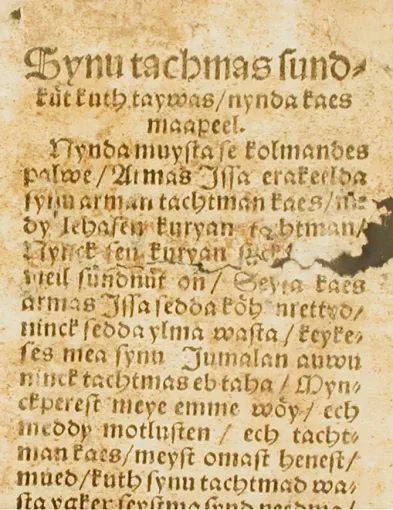
The Wanradt–Koell Catechism is the oldest known printed book in the Estonian language from which some fragments have survived. The book was compiled by Simon Wanradt (1500–1567), pastor of the St. Olaf’s congregation in Tallinn, and Johann Koell (1500–1540), chaplain of the Tallinn Holy Spirit congregation and preacher to the Estonian-speaking congregation. Koell was also the translator of the Estonian-language section.
In 1535, the book was printed in 1,500 copies at the printing house of Hans Lufft in Wittenberg, Germany. However, the catechism was never put into use because the Tallinn City Council found too many errors in it. It is believed that a decisive factor may have been that Wanradt did not fully support Luther’s reformational views.
The Moravian Revival
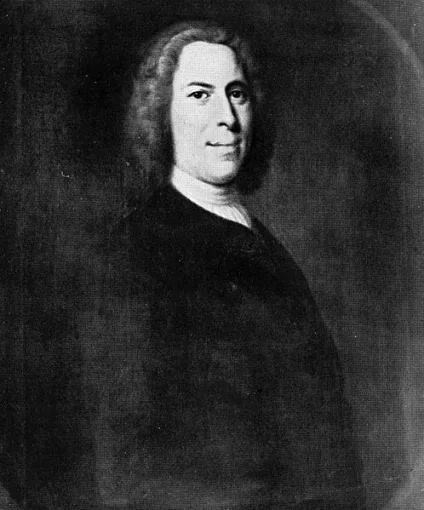
In 1736, Count Nikolaus Ludwig von Zinzendorf (1700–1760) visited the city of Tallinn. He preached at St. Olaf’s Church on 23 September and at Tallinn Cathedral on 26 September. The count’s sermons had a great impact, and many people were converted. A Moravian fellowship group was established, from which the work of the Moravian Brethren movement in Estonia developed.
In 1738, a great revival began in Tallinn, which also reached ordinary people. The number of converts exceeded 400. This was the first known religious revival in Tallinn. By 1740, the number of people who had experienced a deeper spiritual awakening was estimated at 800. The Moravian revival spread throughout Northern Estonia.
The Bible of 1739
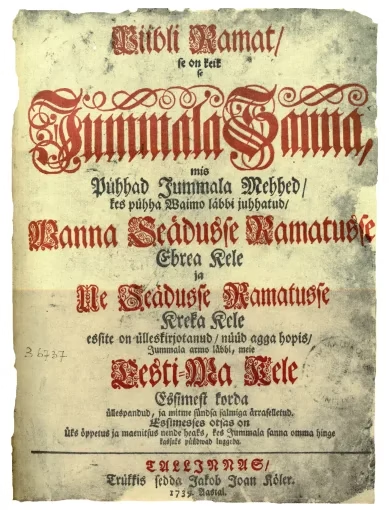
In a sermon preached at St. Olaf’s Church, Count Zinzendorf encouraged support for the publication of an Estonian-language Bible. The manuscript had already been completed, but there was not enough money to print it. The count himself donated a large sum, after which local Germans also contributed.
In 1739, the first complete Estonian-language Bible was published.
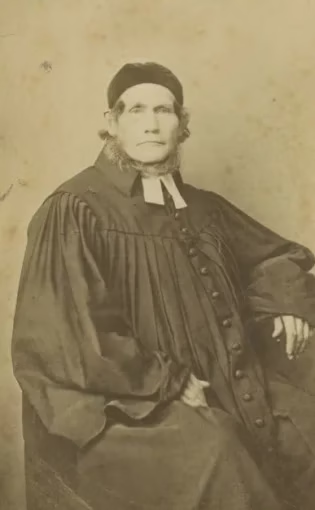
August Ferdinand Huhn
The most prominent evangelist in Tallinn’s Lutheran Church was August Ferdinand Huhn (1807–1871), who served from 1832 until his death as assistant pastor of the St. Olaf’s congregation.
After experiencing a profound spiritual transformation in 1836, conversions began to occur through his preaching. Several later well-known Christian leaders gained personal assurance of salvation through his ministry.
A major revival took place in 1847, when a second parish district was established within the congregation consisting only of converted believers. It had 500 members.
The 1879 Revival in Tallinn
Influenced by the revival in Lääne County, spiritual awakenings also began in Tallinn. Several Free Church and Baptist congregations were established. There was also very active cooperation between different congregations.
A Jewish man named Israel Rubanovitš became a believer and was baptized in St. Olaf’s Church in 1885 according to Lutheran tradition. He took the Christian name Johannes and began proclaiming the Gospel. He became the main figure of the 1905 Stroomi revival. This revival later gave rise to the Evangelical Christian Free Church movement.
Traugott Hahn
The senior pastor of the St. Olaf’s congregation, Traugott Hahn (1848–1939), was a thoroughly evangelical church pastor. He was active in several missionary organizations and initiatives. Although he was of German nationality, he nevertheless preached to Estonians in the Estonian language.
In terms of his religious convictions and spiritual experiences, T. Hahn was a true believer, but he firmly stood on the foundation of confessional Lutheranism. He did not support the activities of the Moravian Brethren, considering their work to have departed from the position of the church. He had a negative attitude toward free churches and referred to emotionally expressive religious work as “Methodist.” However, these views did not prevent him from cooperating with the movements mentioned above.
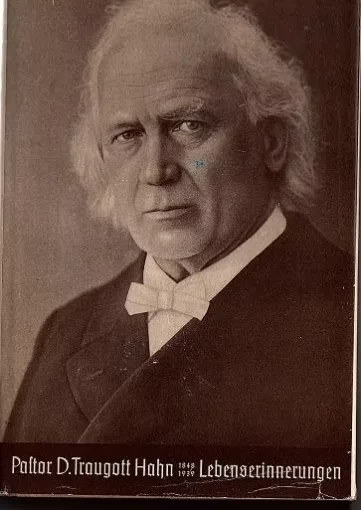
An important part of his evangelical work was inviting well-known evangelical preachers from different parts of Europe to Tallinn, who then preached in St. Olaf’s Church.
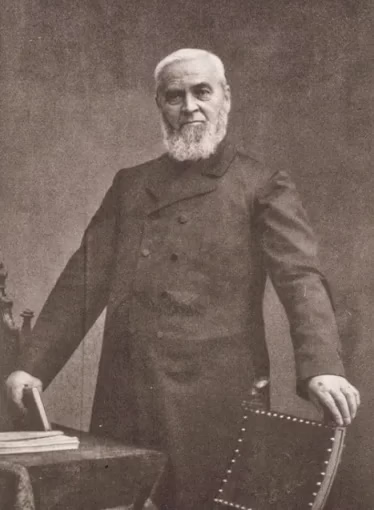
Elias Schrenk
In 1901, Pastor Hahn invited the famous evangelist Elias Schrenk (1831–1913) to preach at St. Olaf’s Church.
Schrenk preached for two weeks, and many people came to living faith. He also held separate meetings for men. Around 4,000 men attended, and many became believers.
Schrenk visited Tallinn again in 1907. His sermons had a powerful impact, and many people turned to God.
The Red Chapter: Olevi People’s House
During the revolution of 1917, St. Olaf’s Church was transformed into the Olevi People’s House, where revolutionaries such as Viktor Kingissepp and others “preached” their message.
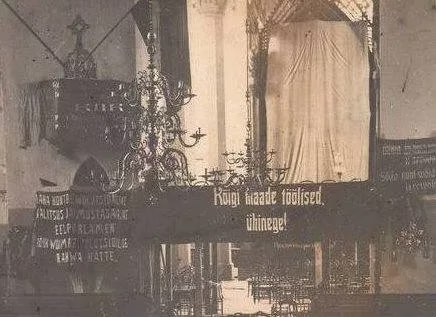
Major Changes in St. Olaf’s Church after the War
The German-speaking Lutheran congregation of St. Olaf’s continued its work until the forced departure of the Baltic Germans in 1939, when the German Lutheran deanery was also dissolved.
Estonian-language services continued in St. Olaf’s Church from June 1941. The Estonian Evangelical Lutheran Church (EELK) Tallinn St. Olaf’s Congregation was established on 27 April 1944.
In August 1950, the EELK Consistory decided to merge the St. Olaf’s and Holy Spirit congregations.
The post-war years brought many changes and reorganizations also among Tallinn’s free churches.
In 1950, Aleksander Veiderpass, the representative of the Council for Religious Affairs of the Estonian Soviet Socialist Republic, ordered that congregations from four different Christian movements be united in St. Olaf’s Church: the Free Evangelicals, Baptists, Evangelical Christians, and Pentecostals.
These included the following congregations:
- Allika
- Iru Betaania
- Eelim
- Immaanuel
- Karmel
- Saaron
- Siion
- Priikogudus
Eight free churches were forced to give up their beloved church buildings and prayer houses and move into the large St. Olaf’s Cathedral.
The church building had suffered serious war damage. It was cold, covered with soot, and bleak.
Many questions had to be solved regarding property, repairs, workers, and worship services. Pastors, organists, choir leaders, office workers, and a caretaker had to be appointed. All of this had to be organized within only a few months.
St. Olaf’s Church required extensive renovation. The roof, windows, heating systems, electrical system — everything needed repair or renewal.
There was also a great need for furnishings: chairs, a harmonium, pianos, music stands, offering boxes, and other equipment. The existing possessions of the former congregations were reviewed to see what could continue to be used.
The Establishment of the St. Olaf’s Congregation
The agreement for the use of St. Olaf’s Church was signed on 4 September 1950.
Senior presbyter Johannes Lipstok informed Archbishop Jaan Kiivit Sr. that the representative of the Council for Religious Affairs had decided to place several free church congregations operating in Tallinn into St. Olaf’s Church:
“Since this church has until now been used by Lutherans, we would like, according to our Christian understanding, to know your position as archbishop regarding this matter. We do not wish that moving into St. Olaf’s Church would create any disturbing feelings among those who are giving up the use of this church, nor do we wish that this event would make the relationship between the two Christian movements in our homeland even colder. We would be grateful if, as the archbishop of the Evangelical Lutheran Church, you could express your goodwill regarding the transfer of St. Olaf’s Church to the Evangelical Christian Baptist congregations. We wish to continue our work in a Christian spirit.”
The first presbyter of the new St. Olaf’s congregation was elected to be Osvald Tärk, a former elder of the Allika congregation and Master of Theology. The second presbyter was Oskar Olvik, former elder of the Karmel congregation.
On 17 September 1950, two large opening services were held. Approximately 3,000 people attended the morning service and nearly 2,700 people attended the evening service.
The united congregations had different emphases and theological traditions, and they now had to find common ground. In addition, there were many restrictions:
- Children’s and youth work was completely forbidden.
- Musical activities were restricted.
- Only selected preachers were allowed to use the pulpit.
Previously, each congregation had many brothers who shared God’s Word. But through prayer, ways were found to continue working in this difficult situation, confined within the thick walls of the church, and to win souls for Christ.
Music ministry became a particularly fruitful way of proclaiming the Gospel. The excellent acoustics of the large church and the enthusiastic participation of many people opened completely new opportunities.
If the authorities of that time believed that these congregations would struggle by continuing together, God showed His grace and blessed the work, causing it to grow.
“When God does something, it is something completely new — something we have never seen before. And if it had not been God’s will that these eight small independent congregations were brought together into this great church, then God’s plan would not have been fulfilled.” — Jüri Puusaag at the 70th anniversary of the congregation, Isaiah 43:18–19